While I've been thinking about design for record release info and the connection to audiences of the time, it's also worth bearing in mind how these have (what with often little in the way of other visual representations) become used for uploads on YouTube. Most usually being vinyl rips and therefore being a particularly relevant visual form.
There are loads of examples of this, but here are just a few:

Showing posts with label Video. Show all posts
Showing posts with label Video. Show all posts
12/12/2010

02/09/2010
Squarepusher - Shobaleader One - d'Demonstrator
Release out 18/10/10 but, for now, a breakneck, exhilirating taster that's a bit like Daft Punk attempting heavy metal. But more scary than 'Aerodynamic'.
I sort of like how someone who is seen as a vanguard of electronica is perceiving the guitar solo as cutting-edge. But mainly I like it as a video with lights in it.
I sort of like how someone who is seen as a vanguard of electronica is perceiving the guitar solo as cutting-edge. But mainly I like it as a video with lights in it.
Squarepusher presents - Shobaleader One - d'Demonstrator from Warp Records on Vimeo.
19/08/2010
Work by Shynola
A few years ago, a work project meant that I had to nip down to London to visit the studio of Shynola. The four-strong team had been doing animation work for the likes of Radiohead, Queens of the Stone Age, Lambchop and Unkle [subsequent commissions have included work for Orange, Nike, Playstation, Natwest and Honda].
Anyway, that name-dropping preamble was really to allow me to say that I've always admired the way that they consistently create an unexpected visual representation for a piece of music and, visiting them, it was obvious that music was a major influence. Before we went to a local pub to chat more informally about their output, that work space was being soundtracked by a succession of material: a lot of it then appeared to be stuff from the Domino roster. But it might have just been on that particular day.
The first featured Blur video in this post - while one of Shynola's - additionally features the unmistakable illustrations of David Shrigley. It's a real contrast to the style employed for the second: a video for Lambchop's 'Is A Woman'. Both are great and beautifully paced.
Anyway, that name-dropping preamble was really to allow me to say that I've always admired the way that they consistently create an unexpected visual representation for a piece of music and, visiting them, it was obvious that music was a major influence. Before we went to a local pub to chat more informally about their output, that work space was being soundtracked by a succession of material: a lot of it then appeared to be stuff from the Domino roster. But it might have just been on that particular day.
The first featured Blur video in this post - while one of Shynola's - additionally features the unmistakable illustrations of David Shrigley. It's a real contrast to the style employed for the second: a video for Lambchop's 'Is A Woman'. Both are great and beautifully paced.
Daydreaming with... James Lavelle
From: Creative Review
Date: 18/08/10
By: Eliza Williams
London-based UNKLE fans are in for a treat next weekend, as the Haunch of Venison gallery hosts a pop-up exhibition celebrating the creative vision of James Lavelle...
Dreaming with... takes place over the UK August bank holiday (August 27-30), and is the first in a series of annual festivals which aim to explore the relationship between music and art. Lavelle (aka UNKLE) is curating this first one, and will bring together works from an extensive list of his collaborators over the years, including Warren Du Preez and Nick Thornton Jones (artwork from UNKLE's latest album Where Did The Night Fall shown top), Jonathan Glazer, Futura, Ben Drury, Kai and Sunny, Oswaldo Macia, Nathan Coley, Simon Birch and Jamie Shovlin. Each artist will create a new artwork inspired by music composed for the project by UNKLE, and the music and art will be combined in the gallery space.
In addition, there will be a screening evening with Lavelle held as part of the festival at the Prince Charles Cinema in Leicester Square on Tuesday, August 31. UNKLE On Screen will feature a selection of UNKLE music videos, including the video for new single The Answer (below), directed by John Hillcoat of The Road fame, and starring Ray Winstone.
There will also be commercials scored by UNKLE shown at the screening as well as the feature film Odyssey in Rome, directed by Alex Grazioli and scored by the band. Following the screening Lavelle will be in conversation with Alex Grazioli and John Hillcoat.
New track The Answer will be released on August 23, to coincide with the exhibition, while UNKLE's new EP, which has provided the inspiration for many of the works that will be on show at Haunch of Venison, will be released on September 13. For more info on the exhibition and screening night, visit daydreamingwith.com.
Date: 18/08/10
By: Eliza Williams
London-based UNKLE fans are in for a treat next weekend, as the Haunch of Venison gallery hosts a pop-up exhibition celebrating the creative vision of James Lavelle...
Dreaming with... takes place over the UK August bank holiday (August 27-30), and is the first in a series of annual festivals which aim to explore the relationship between music and art. Lavelle (aka UNKLE) is curating this first one, and will bring together works from an extensive list of his collaborators over the years, including Warren Du Preez and Nick Thornton Jones (artwork from UNKLE's latest album Where Did The Night Fall shown top), Jonathan Glazer, Futura, Ben Drury, Kai and Sunny, Oswaldo Macia, Nathan Coley, Simon Birch and Jamie Shovlin. Each artist will create a new artwork inspired by music composed for the project by UNKLE, and the music and art will be combined in the gallery space.
In addition, there will be a screening evening with Lavelle held as part of the festival at the Prince Charles Cinema in Leicester Square on Tuesday, August 31. UNKLE On Screen will feature a selection of UNKLE music videos, including the video for new single The Answer (below), directed by John Hillcoat of The Road fame, and starring Ray Winstone.
There will also be commercials scored by UNKLE shown at the screening as well as the feature film Odyssey in Rome, directed by Alex Grazioli and scored by the band. Following the screening Lavelle will be in conversation with Alex Grazioli and John Hillcoat.
New track The Answer will be released on August 23, to coincide with the exhibition, while UNKLE's new EP, which has provided the inspiration for many of the works that will be on show at Haunch of Venison, will be released on September 13. For more info on the exhibition and screening night, visit daydreamingwith.com.
18/08/2010
The Record: Contemporary Art and Vinyl
Great reference spotted by Dave. (Cheers!)
The Record: Contemporary Art and Vinyl features work by 41 artists from around the world, from the 1960s to the present, who use vinyl records as subject or medium. The exhibition includes sound work, sculpture, installation, drawing, painting, photography, video and performance.Artists in the exhibition include Laurie Anderson (1947 USA), Felipe Barbosa (1978 Brazil), David Byrne (1952 Scotland), Janet Cardiff & George Bures Miller (1957 & 1960 Canada)*, William Cordova (1971 Peru), Moyra Davey (1958 Canada), Kevin Ei-ichi deForest (1962 Canada), Jeroen Diepenmaat (1978 Netherlands), Sean Duffy (1966 USA), Yukio Fujimoto (1950 Japan), Jack Goldstein (1945 Canada), Rodney Graham (1949 Canada)*, Harrison Haynes (1973 USA)*, Gregor Hildebrandt (1974 Germany), Satch Hoyt (1957 UK), Jasper Johns (1930 USA), Taiyo Kimura (1970 Japan), Tim Lee (1975 Korea), Ralph Lemon (1952 USA), Christian Marclay (1955 USA), David McConnell (1975 USA), Mingering Mike (1950 USA), Dave Muller (1964 USA), Ujino Muneteru (1964 Japan), Vik Muniz and Carlos da Silva Assunção Filho aka Cafi (1961 & 1950 Brazil)*, Patrick Douthit aka 9th Wonder (1975 USA)*, DJ Rekha (1971 UK)*, Robin Rhode (1976 South Africa), Dario Robleto (1972 USA), Ed Ruscha (1937 USA), Malick Sidibé (1935 Mali), Xaviera Simmons (1974 USA), Mark Soo (1977 Singapore), Meredyth Sparks (1972 USA), Su-Mei Tse (1973 Luxembourg), Fatimah Tuggar (1967 Nigeria), Alice Wagner (1974 Peru), Carrie Mae Weems (1953 USA), and Lyota Yagi (1980 Japan).
The accompanying Cover to Cover installation features 10 artists and musicians who each curated a crate of 20 albums that tell a story through the cover visuals. Visitors will peruse the crates and with headphones listen to records on record players.


13/08/2010
M.I.A. 'XXXO' video teaser
More subversion of formats/media with this teaser for the latest M.I.A. video [a project that turns out to be collaborative effort between Hype Williams, Aaron Platt and the vocalist].
The finished video itself is a bit disappointing by comparison and is built around the kind of ironic twinkling imagery that you can usually find being added as gifs to the MySpace pages of the visually illiterate combined with some knowingly cheesy approximation of cheap Middle Eastern graphics. This, however, is one simple idea that's executed well with a real understanding of where music promotion is now. The technique does make a fairly brief appearance in the full promo although you can't see it having the same edge when viewed on MTV.
The finished video itself is a bit disappointing by comparison and is built around the kind of ironic twinkling imagery that you can usually find being added as gifs to the MySpace pages of the visually illiterate combined with some knowingly cheesy approximation of cheap Middle Eastern graphics. This, however, is one simple idea that's executed well with a real understanding of where music promotion is now. The technique does make a fairly brief appearance in the full promo although you can't see it having the same edge when viewed on MTV.
11/08/2010
Arcade Fire's Synchronised Artwork
From: CR Blog (and forwarded by Amy)
Date: 11/08/10
Back in 2007, director Vincent Morisset reinvented the music video online, with his interactive promo for Arcade Fire track Neon Bible. For the band's latest album, The Suburbs, Morisset has now turned his attention to how digital music files could be more visually exciting...
Morisset has worked with designer Caroline Robert to create a digital artwork that appears when the album is played on mp3 players like the iPod or iPhone. The work deliberately echoes the pleasures of old vinyl record sleeves, where the song lyrics were often written out in full. Each track on the album has an individual image that appears on the iPod screen when it is played, with the lyrics of the song then appearing on the screen as they are sung.
"Win [Butler, Arcade Fire's lead singer], wanted to create a version of the artwork that would be relevant in the digital world," explains Morisset on his website. "Most of us now buy, share and listen to music through computers and portable devices. It seems absurd that it is still a single jpg that is attached to an album in 2010."
"I thought about the relation we have with the vinyl cardboard cover or the paper booklet while listening to the songs. Flipping through the lyrics, looking at a band picture or a cool drawing related to a song while listening to it. With the mp3 player, we lost that. I wanted to find a way to get closer to that experience again."
As with his Neon Bible video, part of the success of the Synchronised Artwork is its simplicity. Explaining how it works, Morisset says, "Tightly sync a series of images with specific moments in a song using the m4a format. Like some podcasters do, but with micro chapters for each line of the lyrics. In addition to that, we were able to add good old hyperlinks also synchonised to the song. This gives the possiblity for the band to add, at any moment, all kinds of references related to each song. They plan to change and update those links occasionally."
The handwritten presentation of the lyrics on the screen works perfectly with the artwork that Caroline Robert designed for the album, which includes photographs shot by Gabriel Jones in the suburbs of Houston. To experience the Synchronised Artwork for yourself, head online to arcadefire.com, where it is included with the purchase of any digital download of the album.


Date: 11/08/10
Back in 2007, director Vincent Morisset reinvented the music video online, with his interactive promo for Arcade Fire track Neon Bible. For the band's latest album, The Suburbs, Morisset has now turned his attention to how digital music files could be more visually exciting...
Morisset has worked with designer Caroline Robert to create a digital artwork that appears when the album is played on mp3 players like the iPod or iPhone. The work deliberately echoes the pleasures of old vinyl record sleeves, where the song lyrics were often written out in full. Each track on the album has an individual image that appears on the iPod screen when it is played, with the lyrics of the song then appearing on the screen as they are sung.
"Win [Butler, Arcade Fire's lead singer], wanted to create a version of the artwork that would be relevant in the digital world," explains Morisset on his website. "Most of us now buy, share and listen to music through computers and portable devices. It seems absurd that it is still a single jpg that is attached to an album in 2010."
"I thought about the relation we have with the vinyl cardboard cover or the paper booklet while listening to the songs. Flipping through the lyrics, looking at a band picture or a cool drawing related to a song while listening to it. With the mp3 player, we lost that. I wanted to find a way to get closer to that experience again."
As with his Neon Bible video, part of the success of the Synchronised Artwork is its simplicity. Explaining how it works, Morisset says, "Tightly sync a series of images with specific moments in a song using the m4a format. Like some podcasters do, but with micro chapters for each line of the lyrics. In addition to that, we were able to add good old hyperlinks also synchonised to the song. This gives the possiblity for the band to add, at any moment, all kinds of references related to each song. They plan to change and update those links occasionally."
The handwritten presentation of the lyrics on the screen works perfectly with the artwork that Caroline Robert designed for the album, which includes photographs shot by Gabriel Jones in the suburbs of Houston. To experience the Synchronised Artwork for yourself, head online to arcadefire.com, where it is included with the purchase of any digital download of the album.


Niklas Roy & Jari Suominen - Laser Cut Phono Record
"We used a vector program to draw the record. With different line colours, we could modulate the laser’s intensity. We also experimented with different depths of the groove within one loop (track 6). Track 2 was something like a random noise experiment where the needle would jump in a different way over the grooves, each time the track is played. So every track has a different idea."
(Excellent use of Youtube as an interactive device too.)
This wouldn't have happened on iTunes
Both Dave and I spotted this on the CR Blog yesterday: a Soho record store dumped a load of vinyl in a skip. Subsequently this prompted one of the biggest bargain bins the Capital has seen.
However, I watched the video and felt a little bit sad. Firstly because all of that specialist jazz and classical music was thrown-out so unceremoniously [due to the shop itself undergoing a refurbishment]. I'm sure that another retailer or a committed collector could have offered it all a more appropriate home. Plus vinyl can also be recycled. But the thing that really got me was how undiscerning the crowd appears to be. Sure, some people appear to be sifting through it as if they're looking for something specific, but generally it feels like a bit of a melee where the material is grabbed with little discrimination. It smacks of its desirability being dictated by vinyl's assumed collectability rather than any need to hear the music itself.
However, I watched the video and felt a little bit sad. Firstly because all of that specialist jazz and classical music was thrown-out so unceremoniously [due to the shop itself undergoing a refurbishment]. I'm sure that another retailer or a committed collector could have offered it all a more appropriate home. Plus vinyl can also be recycled. But the thing that really got me was how undiscerning the crowd appears to be. Sure, some people appear to be sifting through it as if they're looking for something specific, but generally it feels like a bit of a melee where the material is grabbed with little discrimination. It smacks of its desirability being dictated by vinyl's assumed collectability rather than any need to hear the music itself.
09/08/2010
Daft Punk's Daft Card
I previously wrote an essay about Daft Punk's use of visual forms. Specifically it dealt with the representation of man as a robot. And I do really like how the duo creates high-profile work while playing around with notions of anonymity: sometimes I enjoy how it works conceptually more than what they do musically.
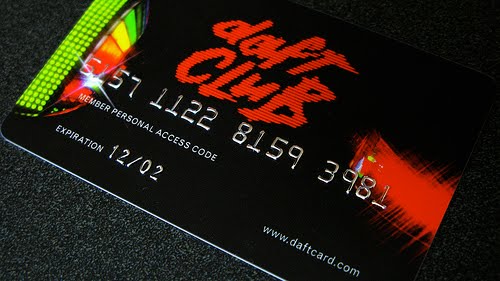
While the French twosome has consistently dabbled outside of traditional music formats with everything from animated films to coffee tables via a Gap commercial, I was always impressed by the 'Daft Card' that came with copies of, second album, Discovery. This gained entry to 'Daft Club': an online resource that allowed for the download of bonus material including extra tracks and remixes. It is telling that this was devised in 2001 as, the first available track, 'Ouverture' begins with the stupid electronic noise of a dial-up connection and remains a testament to the technology of the time [this content has since been released seperately as 'Daft Club', by the way].
The use of the credit card as a physical form also lends itself to discussion regarding the commodification of music yet - let's face it - it was still a handy little object that also fitted neatly into your wallet.

While the French twosome has consistently dabbled outside of traditional music formats with everything from animated films to coffee tables via a Gap commercial, I was always impressed by the 'Daft Card' that came with copies of, second album, Discovery. This gained entry to 'Daft Club': an online resource that allowed for the download of bonus material including extra tracks and remixes. It is telling that this was devised in 2001 as, the first available track, 'Ouverture' begins with the stupid electronic noise of a dial-up connection and remains a testament to the technology of the time [this content has since been released seperately as 'Daft Club', by the way].
The use of the credit card as a physical form also lends itself to discussion regarding the commodification of music yet - let's face it - it was still a handy little object that also fitted neatly into your wallet.
05/08/2010
Matthew Dear - Black City
Another video promoting a music release and this one demonstrates how it is possible to cement a campaign well ahead of the 'product' becoming available. Essentially this is pure graphic design with a combined music/visual aesthetic that should serve Matthew Dear well. This imagery also gives his sometimes more 'pop' alias the edge he desires for, new album, Black City [he also records while using other monikers including the tougher, less vocal 'Audion'] . As his website puts it:
Yet the project also features a further limited edition collectible designed by Boym Partners that investigates a concept central to my own project.
Matthew Dear’s Black City can’t be found on any map. It’s a composite, an imaginary metropolis peopled by desperate cases, lovelorn souls, and amoral motives. Like most literary Gothams, Black City is a place to love and hate, as seedy as a nightclub’s back room and as seductive as the promise of power. Matthew Dear, the musician, may live in New York City, but the Matthew Dear of Black City inhabits a sound-world unlike any other: a monument to the shadowy side of urban life that bumps and creaks, shudders and wakes up screaming in the middle of the night. Black City is Matthew Dear’s third album on Ghostly International, and it’s his darkest and most engrossing work to date.
Matthew Dear - Black City Teaser from Ghostly International
Yet the project also features a further limited edition collectible designed by Boym Partners that investigates a concept central to my own project.
MDBC Totem
Limited Edition of 100
to-tem
1: a) an object serving as the emblem of a family or clan and often as a remainder of its ancestry; also: a usually carved or painted representation of such an object... b) a family or clan identified by a common totemic object.
2: one that serves as an emblem or revered symbolWith Matthew Dear's third studio release, Black City, Ghostly International proudly introduces its newest label release format, the totem. More than a mere limited edition, the totem is a proposal, an entreaty to listeners everywhere to reconsider our relationship to music in the digital era. In producing an object as the embodiment of Black City, Matthew Dear and Ghostly International suggest a new path through which one's physical relationship to an album is again explored.
More information:
"MP3s and digital formats might be convenient and accessible, but sometimes having a physical product—if well-designed, of course—to accompany the music is key."
Taxi: The Global Creative Network
"…now it's time that we make room in our minds for totem to mean something else entirely." XLR8R
"Ghostly is my favourite American record label and the Boyms are my favourite American designers. *And there’s only a hundred of those wacky Boym gizmos, too. That’s what kills me." Bruce Sterling, wired.com
With Matthew Dear's third full-length studio release, Black City, Ghostly International proudly introduces its newest label release format, the totem. More than a mere limited edition, the totem is a proposal, an entreaty to listeners everywhere to reconsider our relationship to music in the digital era. In producing an object as the embodiment of Black City, Matthew Dear and Ghostly International suggest a new path through which one's physical relationship to an album is again explored.
To create Ghostly International's first totem, the company turned to renowned product designers Constantin and Laurene Boym of Boym Partners in New York, recipients of the 2009 National Design Award for Product Design. Widely recognized for their ability to imbue objects with emotional and cultural resonance, the Boym's also have a history of exploring uncharted territory in the world of design. Among their many creations, they have been revered for their "Buildings of Disaster" and "Missing Monuments" series, two ongoing collections which explore the cultural imperative of souvenirs in a postindustrial global economy.
Naturally, they were an ideal choice to task with translating Black City into a three-dimensional object.
The MDBC Totem is both a sculptural representation of the themes explored in Black City and a symbolic conduit to the music itself. Vaguely reminiscent of one of the soot-blackened skyscrapers that might populate Dear's creeping, nameless city, the stacks upon the totem also call to mind the many shaped prongs of a universal power adaptor. In this sense, the totem is not simply a miniature building, but an abstract key to an unknown door. The branding of the totem has been purposefully reduced to its bare essentials—only the letters MDBC and unique alphanumeric suffixes are included—so that the totem's meaning remains discernible only to its beholder.
Each MDBC Totem is inscribed with a unique four-character suffix that will allow users access to a private page on www.matthewdear.com, where Black City may be streamed in its entirely from any web-connected computer, or downloaded. Owners of the totem will also receive an exclusive track, not previously available on the standard album release. Unlike current delivery methods, the totem is a physical format for cloud-based listening, an acknowledgment of two seemingly irreconcilable notions: the need for a tangible representation of music and a future in which music is utterly ethereal.
The MDBC Totem is produced in an edition of 100 units and retails for $125. Each piece has been hand-cast in bonded aluminium with a hand-finished gun metal patina by master-craftsmen in New York City. It is available exclusively at The Ghostly Store.

Kitsune x Ponystep / Album cover photoshoot
To illustrate what I was saying in the previous post about the context changing due to advances in technology, it is worth referencing the campaign for the latest project by French label Kitsune. The album cover here is something that has been devised as 'packaging' yet it also has to exist elsewhere. And not just as the iTunes thumnail either.
Kitsune x Ponystep is also previewed with a video uploaded to YouTube. This demonstrates the process involved in capturing the images via a photoshoot. Yet this has additional advantages by using sample music from the release and also highlights Kitsune's own fashion range. This may not be an appropriate solution for other labels or releases yet it is something that has been previewed when communicated via email newsletters, social networking and blogs. Subsequently it hints at what can be achieved when individuals are not restricted by traditional ideas regarding what constitutes music artwork.

Kitsune x Ponystep is also previewed with a video uploaded to YouTube. This demonstrates the process involved in capturing the images via a photoshoot. Yet this has additional advantages by using sample music from the release and also highlights Kitsune's own fashion range. This may not be an appropriate solution for other labels or releases yet it is something that has been previewed when communicated via email newsletters, social networking and blogs. Subsequently it hints at what can be achieved when individuals are not restricted by traditional ideas regarding what constitutes music artwork.

22/07/2010
05/07/2010
Todd Edwards - 'I Might Be'

Todd Edwards was hugely influential to the development of UK garage. Like fellow Americans Masters At Work, his skippy house rhythms were adopted by the scene here in the UK with special attention paid to his use of sampling. Edwards' approach was to clip elements of the vocal to create a staccato delivery: leaving traces of an actual song reduced to something akin to another, almost percussive instrument. His remix of St Germain's 'Alabama Blues' (1995) is identified as a major turning point within club music. Edwards is also notable for his subsequent collaborations with Daft Punk.
In March of this year he released 'I Might Be' through audio-visual label Scion A/V. The project and its remixes are testament to the existence and continued relevance of Reynolds' Hardcore Continuum with reworks coming from post-dubstep talent Joy Orbison and garage producer MJ Cole [who it should be noted started his recording career as tape operator for drum & bass label SOUR].
In terms of looking for more refined examples of visual referents for music within this point of the continuum, I'm noting the artwork that was created (top image). Unfortunately I can't find a designer credit but there is an additional video promoting the release below which furthers a concept of the esoteric/cosmic/kaleidoscopic meeting sophisticated typography.
Subscribe to:
Posts (Atom)